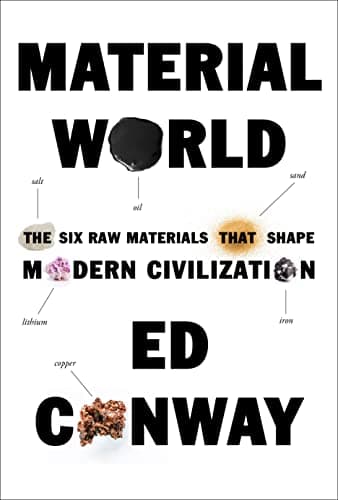
Material World: The Six Raw Materials That Shape Modern Civilization
by Ed Conway
Material World: The Six Raw Materials that Shape Modern Civilization is a 2023 nonfiction book written by Ed Conway.
The six materials explored in the book are sand, salt, iron, copper, oil, and lithium. The book surveys the history of humanity’s extraction and use of these materials and their roles in modern civilization. It also addresses the scale of our extraction and processing of these materials, and the ethical dilemmas of where and how we extract these materials and how it affects the environment.
The book explores stories that span the whole globe and thousands of years of human history. It is an awe-inspiring look at how humans have built civilization, by mining raw materials from the Earth and turning them into useful technologies that have revolutionized human life.
This is a book that helps you understand the modern world. These seemingly humble substances have powered technological revolutions and driven global economics.
This book takes you into the mines and fields where we extract the raw materials, along the supply chain to the places where the materials are refined and processed into other resources, to the organizations that turn these resources into the structures, chemicals, and electricity that allow modern civilization to flourish.
I was not taught about this stuff in school. We take the practical foundations of civilization for granted. Most of us never deal with the raw materials that make up the constructed world around us. Buildings, transportation, electronics, tools, and chemicals are essential to modern life and yet few of us ever really appreciate what has gone into constructing the infrastructure we depend on. Even though the vast majority of us are removed from the mining and processing of these six materials, our lives are deeply attached to the physical reality of these substances.
Sand, something so mundane and abundant, turns out to be one of civilization’s most important materials. It is incredibly useful to us in many ways, from glassmaking, one of humanity’s oldest technologies, to the sand-derived silicon that forms computer microchips, the technology that powers the information age. Glass (essentially melted sand) has allowed us to make lenses to explore worlds that the eye can’t see with microscopes and telescopes, which have transformed our understanding of the universe. Sand is used to make thin glass strands in the fiber optic cables that allow light pulses to carry internet data at near the speed of light, forming the backbone of the modern internet. Sand is also used as an ingredient in concrete, the most widely used construction material on Earth.
Salt is another ordinary substance that turns out to be a foundation of civilization. Salt is so ordinary the book says that if you took the salt from the oceans and evenly spread it on the Earth’s land, it would form a crust 500 feet thick. Salt in the form of sodium chloride (NaCl) helps prevent microbial growth and spoilage by dehydrating food and altering its water activity. Salt historically enabled food preservation that made large, stable societies possible.
Salt also turns out to be a cornerstone of industrial chemistry. Conway calls salt the bedrock for the chemicals and pharmaceuticals industry. Through the electrolysis of brine (saltwater) we obtain chlorine gas, hydrogen gas, and caustic soda. These are among the most important chemicals in the modern world, used for making plastics, medicines, disinfectants, soaps, detergents, paper, and textiles. Thanks to these products we have clean drinking water and clean living conditions.
Iron (mostly used as steel) made mass industrialization possible. Steel is strong, versatile, and relatively cheap. Conway calls steel the skeleton of the modern world. Steel underpins buildings, bridges, railways, cars, ships, and machinery. Without it modern cities, infrastructure, and global trade would be impossible at current scale.
If iron is the skeleton of civilization, Conway argues that copper is its nervous system. Copper's defining property is its extraordinary ability to conduct electricity and heat. Electrification depends fundamentally on copper. Every electrical system from power transmission lines to household wiring to electric motors requires enormous quantities of copper.
Oil is the lifeblood of modern civilization. Unlike most of the other materials, oil is a raw natural material that is often in the headlines and on peoples’ minds. Modern civilization is fundamentally built on oil, and it is one of the greatest drivers of environmental and geopolitical instability. Oil is exceptionally useful to us because it contains an extraordinary amount of energy in a compact form that is easy to store and transport. Oil is not just the fuel that powers our transportation, but a material that is turned into the ubiquitous plastics, synthetic fabrics, pharmaceuticals, fertilizers, and industrial chemicals that show up everywhere in our lives. Oil is such an important material that it has reshaped global power and geopolitics. Ironically enough, the transition to renewable energy sources will require fossil-fuel-intensive supply chains during production. From the mining machinery to the shipping to the plastics involved in the renewable infrastructure, we will still rely on petroleum even in our efforts to transition away from oil.
Lithium is the material of the transition toward an electrified, renewable-energy economy. Batteries allow us to store electrical energy and move it around. Lithium makes for the best rechargeable battery solution that we know of currently because it is the lightest metal and it has remarkable electrochemical properties.
Lithium-ion batteries are not just a big block of lithium though. A battery requires a whole collection of materials. To tie a bow on the book, Conway shows us how the battery revolution requires copper, iron, oil-derived materials, chemicals from salt, and semiconductor technology derived from sand. The technologies of the renewable-energy future, the electric vehicles, solar farms and batteries are still being built from rocks, brines, mines, furnaces, chemical plants, electricity and enormous physical supply chains discussed in other sections of the book.
This book sparked my curiosity and made me appreciate the efforts of civilization more. It includes awe inspiring details about the intricacies of silicon chip making and fiber optic cables. It discusses how technology improvements like fracking are allowing us to find and extract materials more efficiently. The book discusses how important certain places’ mineral resources are to the world economy (copper and lithium in Chile, iron in Australia, ultra-pure quartz in North Carolina essential for semiconductor manufacturing, etc.). There is a fascinating story about how hardened seabird droppings (guano) from South America were once an extremely important source of the world’s fertilizer.
The book shares details about the vast resources at the bottom of the oceans, the incredible scale of how much steel and concrete China have made in recent years, and the unique conditions that led to giant pools of fossil fuels in the Middle East. The book shares how important the Haber-Bosch process has been to expanding the world’s agricultural output and the boundaries of the world’s population. We learn about solution mining, where water is injected into underground salt deposits from evaporated ancient oceans, the salt is dissolved, and the solution is pumped out to be turned back into salt crystals. The book shares detail after detail that made me feel more appreciation for the journey humans have been on to build modern civilization.
The book also makes it clear that there are environmental and geopolitical challenges involved in extracting and using all six of these materials.
For example, steelmaking uses massive quantities of coal. It is heated in a blast furnace which requires extreme heat and energy. Steel production accounts for a significant share of global carbon dioxide emissions. The book also shares an infamous case in Western Australia where an iron mining operation ended up destroying sites considered sacred to the Aboriginal Australians. Mining coal and iron ore are landscape altering endeavors that are environmentally costly.
The book also discusses the block caving technique used for copper mining, where explosives collapse massive ore blocks, digging out enormous craters in the Earth. Clean-energy technologies like solar farms and electric vehicles are especially copper-intensive. Transitioning to “clean” energy will still require the environmentally destructive forces necessary to mine more copper (and many other materials).
Even sand extraction comes with environmental issues like riverbed dredging, habitat destruction, and coastal erosion.
And the demand for these resources is only growing. By 2017, humanity was extracting more raw materials in that single year than in all pre-1950 human history combined. In just a couple of years, China produced more steel than Britain produced over the entirety of the Industrial Revolution. China used more cement in a few recent years than the United States used during the entire 20th century. The book makes it clear that our reliance on these materials is only increasing and that we have many questions and challenges to contend with now and in the future.
This is the kind of nonfiction book that I seek out. I want more books and media teaching us the basics of how the world works at a fundamental level. I want to learn more about how the everyday world works. This is the kind of stuff they don’t teach you in school despite being so incredibly important to civilization. This is ultimately what is shaping global economics, technology, politics, and power. Extracting and transforming these materials poses environmental and ethical challenges that are key to our future. These materials shape the power structure and wealth of the world. Innovations in this stuff can dramatically change the world, our day-to-day lives, and the potential of civilization.
I highly recommend this book. It will spark your curiosity and help you to see the world more clearly.